News
Phi Kappa Phi Member Jimmy Carter Exemplified Lifelong Learning
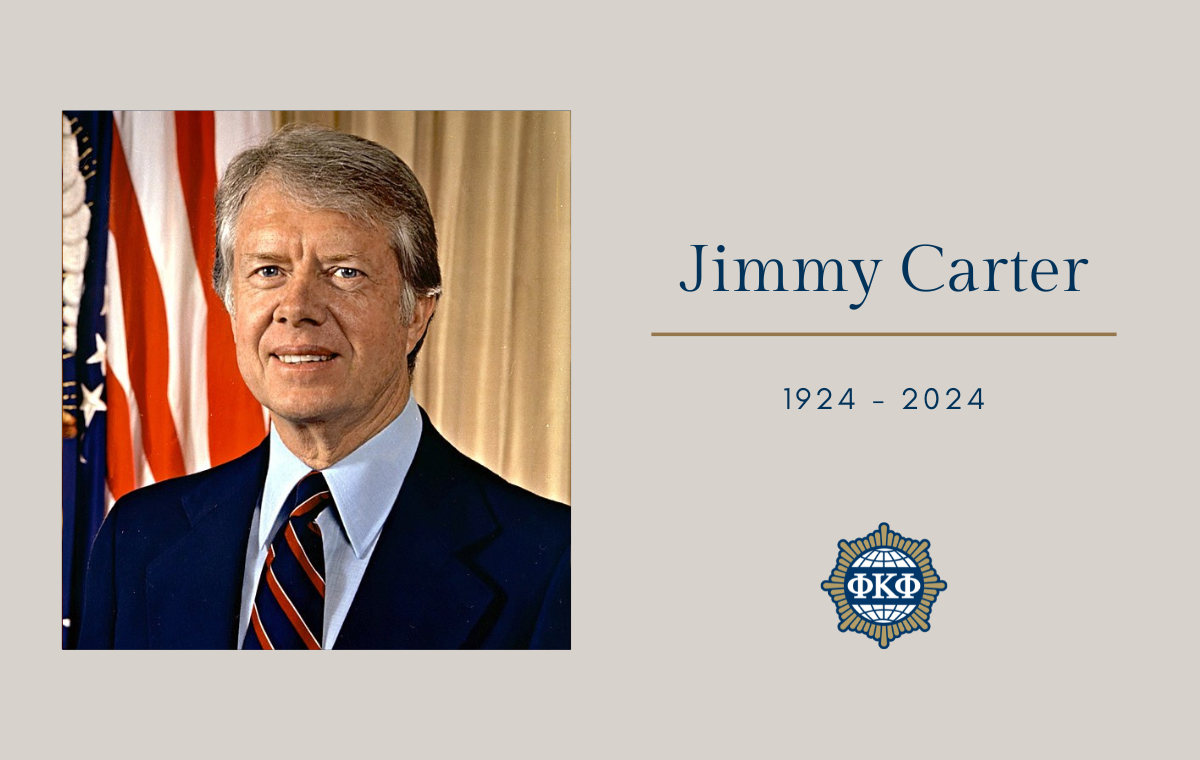
Much will be written about the legacy of Phi Kappa Phi member Jimmy Carter (Georgia State University), who served as president of the United States from 1977 to 1981. Carter died at 100 on Dec. 29.
But the most durable reminder of Carter’s connection with Phi Kappa Phi are the books he wrote, many of which line the shelf of the Society’s collection endowed by Drs. Diane G. and Webb Smathers.
That collection, part of the John R. Baker Library endowed by Kyle Baker in honor of his father, is at Phi Kappa Phi’s national office. It includes a special section devoted to titles by Phi Kappa Phi members. Carter, a prolific author after leaving the presidency, figures prominently in the mix.
Carter wasn’t the first president to work as an author in his post-presidential life. The tradition was popularized by Ulysses S. Grant. Grant had suffered financial problems after leaving office in 1877, and he worried, as he was dying from cancer, that his family would be in trouble after he died. The success of his memoirs, which sold well and were critically acclaimed, inspired subsequent commanders-in-chief to take up the pen after retiring from political office.
Carter also had money worries after leaving office in 1981. While serving as president, he’d left management of his Georgia agricultural business to others, and it ended up deeply in debt. Borrowing a page from Grant, Carter struck a memoir deal to help dig his way out of the red.
Carter kept writing, even after his business headaches were resolved, and he ended up writing some 30 books in all. Some of his books are about politics, but many others, such as “An Hour Before Daylight,” are nonpartisan works that anyone can enjoy. With charm and grace, “An Hour Before Daylight” recounts Carter’s boyhood in rural Georgia, where farm life meant rising early. “My most persistent impression as a farm boy was of the earth,” he writes. “There was a closeness, almost an immersion, in the sand, loam, and red clay that seemed natural, and constant. The soil caressed my bare feet, and dust was always boiling up from the dirt road that passed fifty feet from our front door, so that inside our house the red clay particles, ranging in size from face powder to grits, were ever present in the summertime, when the wooden doors were kept open and the screens just stopped the trash and some of the less adventurous flies.”
Its quite a word picture, carried along with vivid imagery, clarity of expression, and more than a little humor. The length of the sentence also hints at the tendency of Southern talk to go on a bit, as if the story is unfolding on some summer back porch.
Carter worked on books, one gathered, in the same way he made tables in his woodshop – steadily, and with an eye toward unassuming craft.
His reinvention as a writer after leading the free world points the ideal of lifelong learning embraced by Phi Kappa Phi.